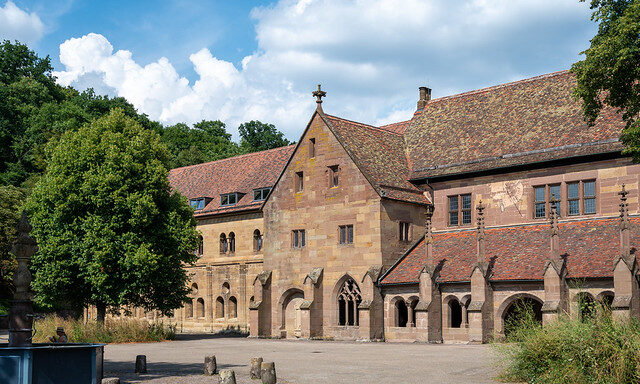
At first glance, Maulbronn might seem like a quick stop to see an old monastery. But once you step inside, you realize there’s much more to explore. I didn’t really know what to expect when I first started looking into how to visit Maulbronn Abbey. If you’re wondering whether it’s worth making the trip, my answer is yes. Maulbronn is one of the best-preserved medieval monastery complexes in Europe, so it’s definitely worth adding to a Baden-Württemberg itinerary. Maulbronn is one of those places where the atmosphere is just as memorable as the architecture, so I’d recommend leaving yourself enough time to explore rather than simply stopping for a quick photo.
🏛️ Quick Travel Facts: Maulbronn Abbey
- 📍 Location: Maulbronn, Baden-Württemberg, southwestern Germany
- 🏰 Official name: Maulbronn Monastery (Kloster Maulbronn)
- 🌍 UNESCO status: A UNESCO World Heritage Site since 1993
- 📅 Founded: 1147 by Cistercian monks
- ⭐ Why visit: One of the best-preserved medieval monastery complexes north of the Alps
- ⛪ Top sights: Monastery church, cloister, monks’ quarters, historic buildings, and monastery museum
- 💧 Interesting detail: The complex includes an impressive historic water-management system developed by the monks
- ⏰ Time needed: Allow around 2–3 hours for a relaxed visit
- 🚗 By car: Visitor parking is available near the monastery, including parking at Friedhofweg/Talaue
- 🚌 By public transport: Maulbronn is accessible by regional public transport.
- 📸 Don’t miss: The cloister and monastery church are among the highlights for architecture and photography
- 🗺️ Perfect for: History lovers, architecture enthusiasts, photographers, and travelers exploring Baden-Württemberg
Why Visit Maulbronn Abbey?
Maulbronn Abbey is one of those places that feels worth visiting even if you’re not usually someone who plans trips around historic buildings. The former Cistercian monastery is incredibly well preserved, and you can explore everything from the impressive church and cloister to the old living quarters and courtyards. I also love that Maulbronn doesn’t feel like a single monument—you’re walking through an entire medieval complex, which makes the visit much more immersive.
A UNESCO World Heritage Site
Maulbronn Abbey has been a UNESCO World Heritage Site since 1993, recognized as one of the best-preserved medieval monastery complexes north of the Alps. The monastery was founded by Cistercian monks in 1147, and its buildings reflect several centuries of architectural development.
A few things that make its UNESCO status particularly interesting:
- 🏰 Medieval architecture: The complex preserves an impressive mix of Romanesque and Gothic styles.
- 📜 Long history: The monastery was founded in 1147 and played an important role in the region for centuries.
- 🧱 Remarkably preserved: Much of the original monastery complex has survived, giving visitors a rare glimpse into medieval monastic life.
- 🌿 Historic surroundings: The buildings, courtyards, gardens, and surrounding landscape are all part of the experience.
For me, the UNESCO designation is a good reason to put Maulbronn on your Germany itinerary, but the real appeal comes when you start exploring the site yourself.
What Makes Maulbronn Abbey Special?
What makes Maulbronn particularly interesting is that you’re not simply visiting an old church. The entire monastery complex has survived, so you can walk through many of the spaces that once made up the monks’ daily lives.
Here are a few highlights to look out for:
- 🕍 Monastery church: One of the architectural highlights, with elements from different periods.
- 🌿 Cloister: A peaceful and atmospheric part of the complex, and one of my favorite places to slow down and look at the details.
- 🍽️ Refectory: The historic dining area gives you an idea of how the monks lived and organized their daily routines.
- 🛏️ Monastic buildings: Former living and working spaces help bring the history of the monastery to life.
- 💧 Water-management system: The monks created an extensive network of ponds, channels, and other waterworks around the monastery.
- 📸 Courtyards and stonework: There are plenty of beautiful architectural details to notice, so it’s worth exploring at a relaxed pace.
If you have 2–3 hours, you can see the main highlights without rushing. And if you enjoy history, architecture, or photography, you’ll probably find yourself wanting to stay a little longer.
How to Get to Maulbronn Abbey
Please note that some of the links on the website might be affiliate links, which means that at absolutely no extra cost for you our website will earn a small commission. Thank you for supporting this project! Our Disclaimer
Maulbronn is located in southwestern Germany, between Stuttgart, Karlsruhe, and Heidelberg, so it’s fairly easy to reach by car or public transport. The easiest option depends on where you’re coming from, but I found driving particularly convenient if you’re combining the abbey with other stops in the region.
Getting to Maulbronn by Train
Getting to Maulbronn by train takes a little more planning because the main railway stop, Maulbronn-West, is outside the town rather than directly beside the abbey. From there, you can continue by bus 735 into Maulbronn.
There is also a much more convenient seasonal option:
- 🚂 Freizeitexpress Kloster Maulbronn: This special train connects Maulbronn with the surrounding region on Sundays during the warmer months. For the seasonal Freizeitexpress Kloster Maulbronn, check the current timetable on the official Freizeitexpress website before you travel.
- 📅 In 2026, the service runs through October 18, although there are some exceptions, including August 23 due to construction work.
- 🚌 From Maulbronn-West, the regular bus connection can take you into town.
- 🎫 Check the current timetable before your journey, as seasonal services and connections can change.
If you’re visiting specifically for the abbey, I’d check the train and bus connections before setting off rather than assuming a train will take you directly to the monastery.
Getting to Maulbronn by Bus
For many visitors, the bus is actually one of the simplest ways to reach Maulbronn without a car. Bus 700 connects Maulbronn with Bretten and Mühlacker, while bus 735 runs from Pforzheim.
A few useful things to know:
- 🚌 Bus 700: From Bretten or Mühlacker
- 🚌 Bus 735: From Pforzheim and also connects Maulbronn-West with the town
- 🚶 Once you’re in Maulbronn, the monastery is easy to reach on foot.
- 🕐 Services can vary by day, so check your route on the VPE or bwegt journey planner before setting off.
If you’re coming from Stuttgart or Karlsruhe, I’d look at the full connection through Mühlacker, Bretten, or Maulbronn-West rather than searching for a direct train to the abbey.
Driving to Maulbronn Abbey
If you’re road-tripping through Baden-Württemberg, driving is probably the easiest option. Maulbronn is accessible from both the A5 and A8 motorways, and the town has free visitor parking close to the UNESCO site.
📍 For your GPS, the town recommends entering: Friedhofweg, 75433 Maulbronn
Visitor parking is available around the monastery, including the Friedhofweg/Talaue area. Follow local parking signs when you arrive.
Visiting Maulbronn as a Day Trip
Maulbronn works really well as a day trip, particularly if you’re already exploring southwestern Germany. You don’t necessarily need a full day just for the abbey—I’d allow around 2–3 hours to explore the monastery at a comfortable pace, then use the rest of the day to see more of Maulbronn or combine it with another nearby destination.
A simple day-trip plan could look like this:
- ☕ Morning: Arrive in Maulbronn and grab a coffee or breakfast.
- ⛪ Late morning: Explore Maulbronn Abbey, including the church, cloister, and monastery buildings.
- 📸 Afternoon: Take some time to walk around the historic town and surrounding area.
- 🍽️ Lunch: Stop for a relaxed meal before heading back.
- 🚗🚆 Later afternoon: Continue your road trip or return by public transport.
If you have the choice, I’d visit on a weekday or arrive relatively early. Maulbronn is much more enjoyable when you can take your time in the cloister and historic buildings without feeling rushed. The monastery is open daily from March 1 through October 31, with different hours in the winter season.
Good places to combine with Maulbronn
🏰 Ludwigsburg — about 40 km away. A great choice if you enjoy palaces and gardens; the main attraction is the impressive Ludwigsburg Residential Palace. Read more about Ludwigsburg itinerary
🏘️ Knittlingen — only about 6 km away. This is a nice short add-on if you don’t want to spend much time traveling. You can visit the Faust Museum, dedicated to the historical figure who was born in Knittlingen.
🌳 Zaberfeld & Stromberg-Heuchelberg Nature Park — around 14 km away. I’d recommend this if you want to balance the abbey’s history with some time outdoors. The nature park centre at Ehmetsklinge has interactive exhibits and outdoor activities.
🎢 Tripsdrill — around 31 km away. This is the fun option, particularly for families, with an amusement park and wildlife park.
⛪ Hirsau Monastery — a particularly good choice if you’re interested in medieval monasteries. Maulbronn is part of the Northern Black Forest Monastery Route, which also includes Hirsau, Wildberg and Alpirsbach.

Maulbronn Abbey Opening Hours
Before planning your visit, it’s worth checking the opening hours because Maulbronn Abbey has different schedules in summer and winter. The official visitor information also notes that the last admission is 45 minutes before closing, so I wouldn’t arrive right at the end of the day.
Opening Hours from March to October
From March 1 to October 31, Maulbronn Abbey is open daily, including public holidays, from 9:30 am to 5:30 pm. The last admission is at 4:45 pm.
- 📅 Days: Monday–Sunday + public holidays
- 🕤 Opening: 9:30 am
- 🕠 Closing: 5:30 pm
- 🚪 Last admission: 4:45 pm
- ☀️ Best time to visit: I’d aim for the morning if you want a quieter experience, especially during the summer season.
This is also the best season if you want to combine the abbey with a walk around Maulbronn or explore the surrounding countryside.
Opening Hours from November to February
The winter schedule is slightly shorter. From November 1 to February 28, the monastery is open Tuesday to Sunday and public holidays from 10:00 am to 4:30 pm. The last admission is at 3:45 pm.
- 📅 Days: Tuesday–Sunday + public holidays
- 🕙 Opening: 10:00 am
- 🕟 Closing: 4:30 pm
- 🚪 Last admission: 3:45 pm
- 🚫 Monday: Closed during the winter season
If you’re visiting in winter, I’d plan to arrive around 10:00–11:00 am so you have plenty of time to explore before the earlier closing time.
How Much Time Do You Need at Maulbronn Abbey?
I’d allow around 2–3 hours for a first visit. That gives you enough time to explore the main monastery buildings, see the church and cloister, and take a few minutes to appreciate the details rather than rushing through.
If you’re interested in the history, I’d allow a little longer, especially if you want to join a guided tour. The standard guided tour takes about one hour, and tours are offered several times a day depending on the season.
A rough guide:
- ⚡ 1 hour: Quick visit and main highlights
- 🏛️ 2 hours: Comfortable visit to the main monastery complex
- 📸 2–3 hours: My recommendation for a relaxed visit with time for photos
- 🎧 3+ hours: Better if you want a guided tour, museum experience, and time to explore at a slower pace
Don’t underestimate the size of the complex. I’d rather give Maulbronn 2–3 hours than squeeze it into a rushed one-hour stop—you’ll have much more time to enjoy the cloister and the atmosphere of the former monastery.
Maulbronn Abbey Tickets and Prices
For 2026, a standard adult ticket costs €10, while you can also choose a ticket that includes either the standard guided tour or an audio guide for €13.
H3: Admission Prices
Here are the current admission prices:
- 👤 Adults: €10
- 🎓 Reduced admission: €5
- 👨👩👧👦 Family ticket: €25
- 👥 Groups of 20+: €9 per person
- 📅 Annual pass: €50
- You can also check prices on the official Maulbronn Monastery website
If you want to learn more about the monastery while you’re there, the combined ticket is:
- 🎧 Adults: €13 — admission + audio guide or standard guided tour
- 🎓 Reduced: €6.50
- 👨👩👧👦 Family: €32.50
- 👥 Groups of 20+: €11.70 per person
The audio guide is available in German, English, French, Italian, Spanish, and Japanese, which is particularly useful if you’re visiting independently.
Guided Tour and Audio Guide Prices
The standard guided tour lasts approximately one hour and covers the main highlights of the monastery. It costs the same as the combined admission + audio guide ticket:
- 🏛️ Adults: €13
- 🎓 Reduced: €6.50
- 👨👩👧👦 Families: €32.50
Standard tours are offered several times a day, with more departures during the March–October season. English and French tours can also be arranged, while regular standard tours are primarily offered in German.
Who Can Get a Reduced Ticket?
The €5 reduced admission applies to several groups, including:
- 👧 Children aged 6 and over
- 🎒 School students up to age 28 with valid student ID
- 🎓 University students up to age 28 with valid student ID
- 🪖 People doing voluntary military service with valid ID
- 🤝 People doing recognised voluntary social, ecological, or federal volunteer service
- ♿ Visitors with a registered disability of 50% or more, with appropriate documentation
Anyone aged 15 or over is normally considered an adult, unless they qualify for a reduced ticket.
Should You Book a Guided Tour?
If you ask me, yes — especially if this is your first visit to Maulbronn. The monastery has a long and complicated history, and a guide can help you understand what you’re looking at instead of simply walking through beautiful medieval buildings.
I’d choose a guided tour if:
- 🏰 You want to understand the history and architecture.
- 📖 You enjoy hearing the stories behind historic places.
- ❓ You have questions and prefer having someone explain the details.
- 👨👩👧👦 You’re visiting as a family and want the history to be more engaging.
On the other hand, an audio guide is a great option if you prefer traveling independently. And if you’re mainly interested in photography and atmosphere, the basic €10 admission may be all you need.
If you have around 2–3 hours at Maulbronn, I’d spend the extra €3 on the combined ticket. It’s a relatively small upgrade, and the guided tour adds much more context to what you’re seeing.
What to See at Maulbronn Abbey
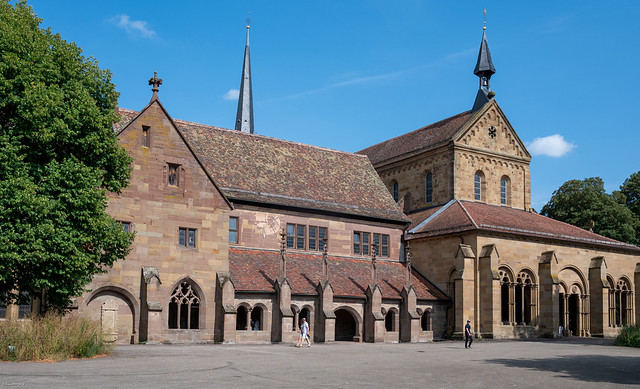
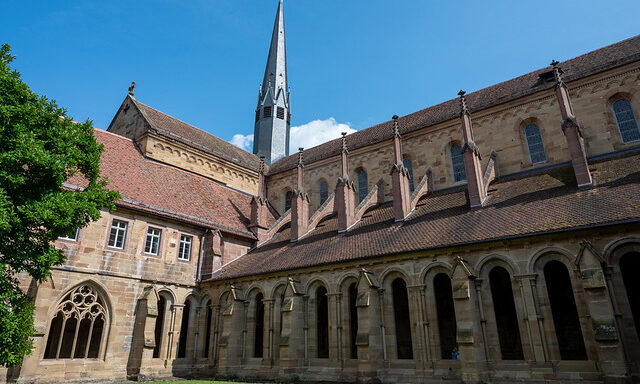
One of the best things about Maulbronn is that there’s much more to see than just the monastery church. The complex is remarkably intact, so you can walk from the church into the cloister, courtyards, museums, and other buildings that once formed part of everyday monastic life. The combination of Romanesque and Gothic architecture is what makes exploring here so interesting.
The Monastery Church
The Monastery Church is the heart of Maulbronn and one of the first places I’d visit. The Romanesque church was consecrated in 1178, and later alterations introduced beautiful Gothic elements. Inside, you can see the contrast between the simple Cistercian design and later additions, including the impressive Gothic net vault.
A few details worth looking for:
- 🏛️ Romanesque nave dating back to the original medieval church
- ✨ Gothic net vault added in the 15th century
- 🎨 Medieval artwork and murals
- 🚪 The historic “Door of the Dead” in the south transept
- 🏰 The Romanesque choir screen that once separated the monks from the lay brothers
The Gothic Cloister
The cloister is probably one of the most atmospheric parts of Maulbronn. It connected the monastery’s most important rooms, including the church, chapter house, dormitory, and dining hall. The cloister was built in several stages, so you’ll notice a mixture of Romanesque and Gothic details as you walk around it.
I’d take your time here rather than simply walking through. Look closely at the stonework, especially the foliated capitals and the carved plant and animal motifs in the western wing.
- 🌳 Cloister garden: A peaceful place to pause
- 🏛️ South wing: An early Gothic highlight dating from around 1210–1220
- 🌿 Carved capitals: Beautiful plant-inspired details
- 🐾 West wing: Look for medieval animal and floral motifs
The Fountain House
The Fountain House is one of Maulbronn’s most recognizable buildings, thanks to its famous three-bowl fountain. The monks used this space for washing, ritual cleansing, and cutting their tonsures. Its water came from springs in the hills north of the monastery.
There’s also a fun connection to the history of Maulbronn itself. Look up at the ceiling and you’ll find red-ochre paintings, including a depiction of the mule legend associated with the monastery’s foundation.
- ⛲ Three-bowl fountain: The building’s most famous feature
- 💦 Spring water: Originally supplied the fountain
- 🎨 Historic ceiling paintings: Some original decoration survives
- 🐴 Mule legend: Look for the scene connected to the founding story
The Paradise
Don’t skip the Paradise, the entrance hall of the monastery church. Built around 1220, it is considered one of the finest examples of Early Gothic architecture at Maulbronn. The architect is unknown, so he is simply referred to as the “Paradise Master.”
The name might sound a little mysterious, but there’s a reason for it. Church vestibules were traditionally decorated with scenes of the Fall of Man, and the space was therefore associated with Paradise.
- 🏛️ Early Gothic masterpiece
- 📅 Dating to around 1220
- 🚪 Nearly 900-year-old church doors
- 🎨 Remnants of medieval color can still be seen
- 🔨 Created by the mysterious Paradise Master
For me, this is one of the places where it’s worth slowing down and looking upwards—the architectural details are easy to miss if you simply walk through.
The Monastery Museums
If you want more context about what you’re seeing, make time for the Monastery Museums. There are several exhibitions spread across historic buildings, covering everything from Cistercian life and the monastery’s history to its later use as a Protestant school.
The main exhibits include:
- 🗺️ Information centre: Includes a large model of the monastery complex
- 📜 Museum in the Frühmesserhaus: Covers the founding of Maulbronn, Cistercian life, and the monastery’s medieval history
- 🪨 Lapidarium in the cellarium: Displays original stonework from the monastery
- 🏫 Post-Reformation history: Learn about the monastery school and Maulbronn’s later history
If you’re interested in the stories behind the buildings rather than just the architecture, I’d definitely include the museums in your visit.
The Medieval Monastery Courtyards
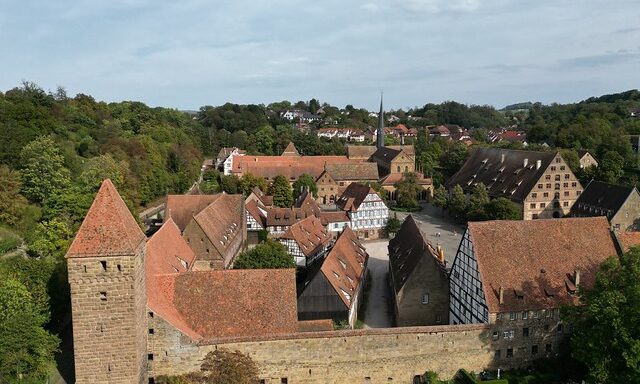
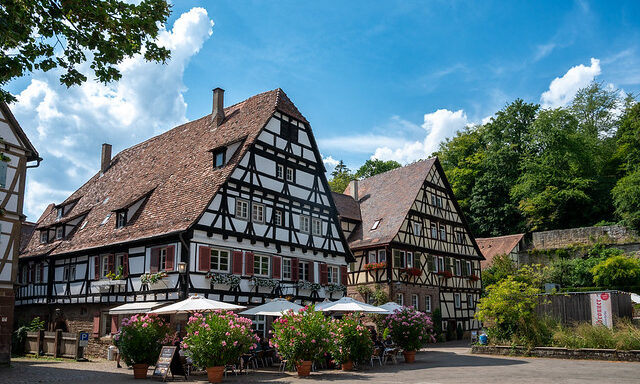
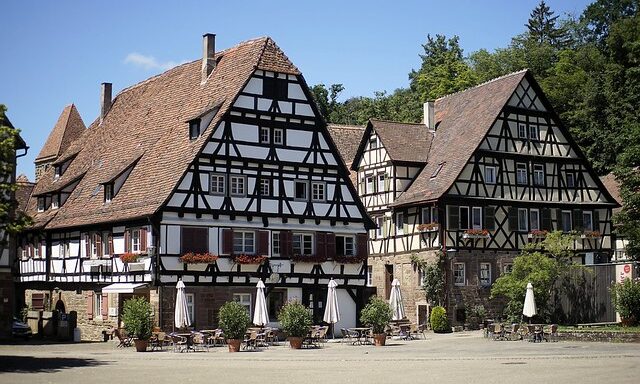
The courtyards are part of what makes Maulbronn feel like a complete medieval settlement rather than a single historic monument. The monastery is enclosed by medieval walls and towers, with numerous former working and residential buildings surrounding the main areas.
As you wander around, keep an eye out for:
- 🧱 Medieval walls and towers
- 🏘️ Historic outbuildings around the courtyards
- 📸 Architectural details that are easy to miss from the main tourist route
- 🏛️ The contrast between the grand monastery buildings and the more practical spaces used for everyday life

Visiting Maulbronn Abbey with Children
Maulbronn Abbey can be a surprisingly good family stop, especially if your children enjoy hands-on activities and stories about medieval life. Instead of simply walking around looking at old buildings, families can explore how the Cistercian monks lived, worked, ate, and spent their days. The monastery also offers a dedicated interactive experience for children aged 8 and over, making the visit much more engaging for older kids.
The Young Monastic World
One of the best things to do with children is The Young Monastic World, a hands-on experience designed for children and teenagers aged 8+. It takes place in a former administrative building in the monastery courtyard, where children can step into the world of the Cistercian monks.
Rather than just reading about history, children get to take part:
- 🧑 Become a novice: Children take on the role of young monks and even receive a new monastic name.
- ✍️ Try writing with a quill: A fun way to experience one of the skills used in medieval times.
- 🧱 Build a Roman arch: Kids can experiment with how medieval architecture worked.
- 🍽️ Discover monastic table manners: They can learn about meals and everyday rules in the monastery.
- 👥 Meet five fictional characters: These guides introduce children to different aspects of monastic life.
- 🎭 Learn through play: The whole experience is designed around hands-on discovery rather than simply listening to information.
The Young Monastic World is only available as part of a guided experience, and a time slot needs to be booked in advance. It costs €5 per adult or €2.50 reduced, in addition to the monastery admission.
Family-Friendly Things to See
Even without the children’s experience, there are plenty of things that can make a visit more interesting for younger travelers. I’d turn the visit into a little medieval treasure hunt and encourage kids to look for unusual details as you explore.
Here are some things to look out for:
- ⛪ Monastery church: Look up at the impressive Gothic vault and search for interesting details in the medieval building.
- 🌿 Cloister: Let children look closely at the carved plants, animals, and other stone details.
- ⛲ Fountain House: The three-bowl fountain is one of the most recognizable features of the monastery.
- 🐴 Mule legend: The Fountain House has a connection to the traditional story about the monastery’s foundation.
- 💧 Water system: Talk about how the monks collected and managed water around the monastery—an easy way to turn the history into a story.
- 🏘️ Courtyards: The large historic complex gives children plenty of space to see how a medieval monastery functioned as a community.
- 🎧 Audio guide: For older children who enjoy history, an audio guide can make the buildings easier to understand.
If you’re visiting with children 8 or older, I’d seriously consider booking the Young Monastic World. It turns what could otherwise be a fairly traditional historical visit into something much more interactive. There are also special family tours combining the monastery tour with the Young Monastic World; these typically last around 2 hours.

What to See Near Maulbronn Abbey
Maulbronn Abbey is the main attraction, but I’d definitely leave some time to explore beyond the monastery walls. The town itself has a charming historic atmosphere, while the surrounding landscape is part of the wider cultural landscape created by the monks. If you have a car, there are also several interesting places within easy reach of Maulbronn.
Exploring Maulbronn Old Town
Once you’ve finished exploring the monastery, it’s worth spending a little time outside the abbey complex. Maulbronn is surrounded by the historic Cistercian cultural landscape, with vineyards, orchards, woodland, and former monastery ponds. You don’t need to commit to a long hike either—there are a couple of easy walks that work well after a monastery visit.
🍇 Kultur- und Weinlehrpfad am Klosterberg: This is probably the best short walk to add to your visit. The 1.4-km circular trail starts and finishes close to the monastery and climbs the Klosterberg through vineyards and orchards. Along the way, information panels explain local wine-growing, the history of the Klosterberg, and how the Cistercian monks shaped the landscape. There’s also a viewpoint called “Auf den Schranken”, with views over Maulbronn and the monastery.
🌊 Tiefer See: After the wine trail, you can walk down to Tiefer See, a former fish-farming reservoir created by the Cistercian monks. It’s just a short walk from the monastery and is one of the most visible reminders of the monks’ sophisticated water-management system. Important for 2026: the lake and kiosk are currently closed for extensive renovation, and the surrounding area is partly restricted. If you visit in 2026, check the latest local information before planning a walk around the lake.
💧 The Mahlrinne path: If you want an especially easy stroll, look for the narrow Mahlrinne path leading from the monastery towards Tiefer See. The path follows the historic water landscape and is a nice way to connect the monastery with the former fish pond.
🐦 Aalkistensee and Roßweiher: For a longer walk, head beyond the town towards the former monastery fish ponds. Aalkistensee and Roßweiher are now nature reserves and form part of the wider landscape created by the Cistercians. The official monastery site recommends routes around these former monastery lakes for visitors interested in seeing the monks’ historic water-management system.
🚶 Maulbronn–Aalkistensee walk: If you have more time, an older Maulbronn tourism guide describes a 4.5-km route from the town centre to Aalkistensee, passing through the former monastery outpost Elfingers Hof along the way. This is a better choice if you want to turn your monastery visit into a proper countryside walk rather than just taking a short stroll.
For most visitors, I’d stick with the 1.4-km Klosterberg wine trail + Tiefer See. It gives you vineyards, views, orchards, and one of the historic monastery ponds without turning your visit into a serious hike. If you’re particularly interested in the Cistercians’ water system, then extend your walk towards Aalkistensee and Roßweiher.
Other Attractions Near the Monastery
If you have a little extra time after visiting the abbey, you can explore some of the lesser-known places around Maulbronn. I’d especially recommend staying close to the town and exploring the surrounding Stromberg-Heuchelberg landscape, rather than immediately jumping in the car for another major attraction.
🗼 Sternenfels: About 10 km from Maulbronn, this small wine-growing town is worth visiting for its Schlossbergturm, a lookout tower with wide views across the surrounding landscape. There are also walking routes through the local vineyards and forests.
🍷 Oberderdingen: A lovely choice if you enjoy wine villages. You can explore the historic Amthof and town centre, then head up to Derdinger Horn, a viewpoint overlooking the Kraichgau landscape and vineyards.
🏰 Ravensburg Castle: Near Sulzfeld, the medieval Ravensburg sits above the surrounding vineyards and makes a nice stop if you’re interested in castles and countryside views.
🦶 Ötisheim Barefoot Trail: For something completely different, the 1.4-km barefoot trail near Ötisheim has around 20 sensory stations using materials such as sand, gravel, wood, and bark. It’s particularly suitable if you’re traveling with children.
🌲 Eppinger Linien-Weg: History lovers and hikers can follow sections of this 41.9-km trail between Eppingen and Mühlacker. The route follows the historic defensive line built in the late 17th century and passes through Sternenfels and Maulbronn. You don’t need to hike the entire route—individual sections work well for a shorter walk.
Combining Maulbronn with a Day Trip in Baden-Württemberg
Rather than adding another big city to your itinerary, I’d consider making Maulbronn part of a history-and-landscape day. The area around the monastery is particularly good for combining medieval sights with vineyards, viewpoints, and walking routes.
Here are a few ideas:
- 🏰 Maulbronn + Sternenfels: Visit the monastery in the morning, then drive to Sternenfels for the Schlossbergturm and a walk through the surrounding vineyards.
- 🍷 Maulbronn + Oberderdingen: A good option for a slower day, combining the monastery with a historic wine village, Derdinger Horn, and the Kraichgau countryside.
- 🥾 Maulbronn + Eppinger Linien: If you enjoy hiking, spend the morning at the monastery and then walk a section of the historic Eppinger Linien-Weg.
- ⛪ Maulbronn + the Northern Black Forest Monastery Route: For serious history lovers, you could extend your trip beyond Maulbronn to Hirsau, Wildberg, and Alpirsbach. These four medieval monasteries form the Northern Black Forest Monastery Route and can be explored by car, bicycle, or on foot over several days.
My pick for a one-day itinerary: I’d go with Maulbronn + Sternenfels or Oberderdingen. They keep you in the same beautiful Kraichgau-Stromberg landscape and give you a nice change of pace after spending a few hours inside the monastery.
FAQ About Visiting Maulbronn Abbey
Is Maulbronn Abbey worth visiting?
Yes, especially if you enjoy history, architecture, and UNESCO World Heritage Sites. Maulbronn is one of Europe’s best-preserved medieval monastery complexes, and what I like most is that you can explore much more than just a church. The cloister, Fountain House, Paradise, courtyards, and museums all help you understand how the monastery once functioned as a small self-contained community.
I’d definitely add it to a Baden-Württemberg itinerary if you’re already traveling around southwestern Germany. It’s also a good choice for a half-day visit rather than something that requires an entire day.
How long do you need at Maulbronn Abbey?
I’d allow 2–3 hours for a comfortable first visit. This gives you enough time to see the monastery church, cloister, Fountain House, Paradise, museums, and courtyards without having to rush.
If you’re mainly interested in the architecture, you could see the highlights in around 1–2 hours. I’d allow longer if you’re taking a guided tour or want to explore the museums in more detail.
Can you visit Maulbronn Abbey without a guided tour?
Yes. You can explore the monastery independently with a standard admission ticket. If you’d like some additional information without joining a group, an audio guide is a good middle option and is available in several languages, including English.
There are also regular guided tours in German, with English and French tours available as well.
For a first visit, I’d choose the audio guide or a guided tour. But if you prefer taking photos and exploring at your own pace, visiting independently works perfectly well.
How do you get to Maulbronn Abbey by public transport?
The simplest options are:
- 🚌 Bus 700: Connects Maulbronn with Bretten and Mühlacker.
- 🚌 Buses 734/735: Connect Maulbronn with Pforzheim.
- 🚂 Klosterstadt-Express: The seasonal train stops in Maulbronn on Sundays and public holidays from May to October.
If you’re traveling by public transport, check the connection for your exact date before leaving, particularly for the seasonal train service.
Is Maulbronn Abbey suitable for children?
Yes, particularly for children aged 8 and over. The monastery has a dedicated interactive experience called “The Young Monastic World,” where children can step into the role of novice monks and learn about medieval monastic life through hands-on activities. They can try writing with a quill, build a Roman arch, and discover how monks lived and worked.
For families, I’d plan around 2–3 hours and consider one of the special family tours offered during the 2026 season. The monastery has specifically expanded its family and children’s programme for 2026.
Take a note! When going on a trip to Germany, do not forget to take out travel insurance, which is useful for receiving a tourist visa and for solving emerging medical problems when travelling in another country. You can purchase insurance via online services, for example, via EKTA and others. You can choose from different modes, including quiet, active or extreme rest.
Photo above the article: Xiquinho Silva

Julia is an experienced traveller, BA in International Relations and Languages and true lover of planning trips in advance. Learn more about the author…


